
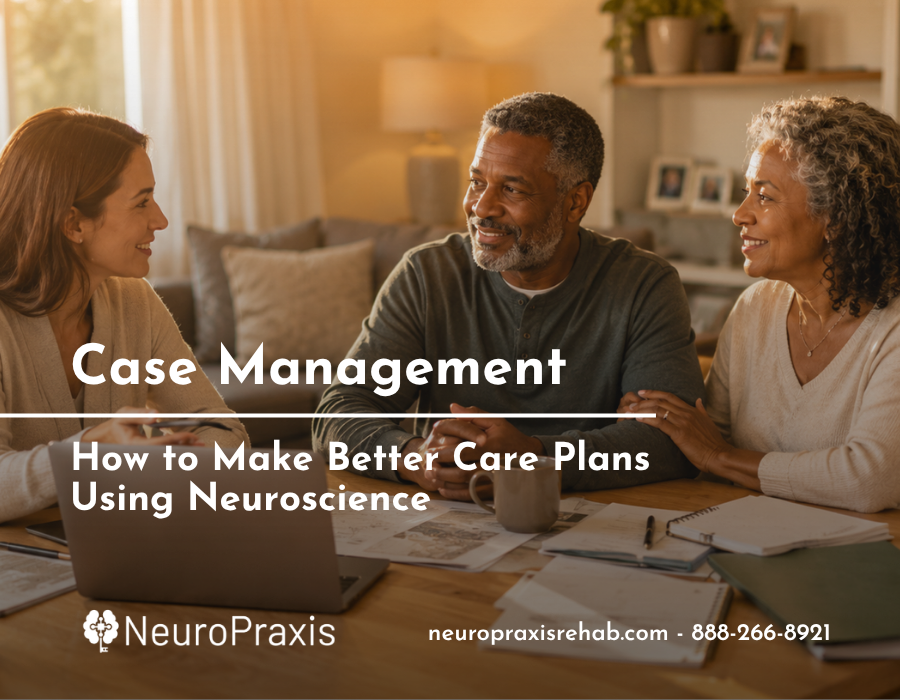
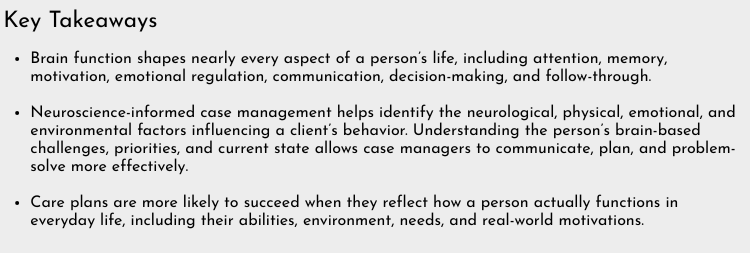
A care plan can be carefully designed and clinically sound and still prove ineffective if it doesn’t meet the client where they are. A person’s ability to engage is influenced by the current state of their brain and nervous system, as well as pain, fatigue, stress, trauma, cognitive demands, relationships, environment, and competing pressures. Neuroscience-informed case management helps case managers see the situation from the client’s perspective, reduce overwhelm and threat, and connect the plan to the individual’s needs, priorities, and motivations. Seeing clients through this lens encourages case managers to look beneath the behavior and ask a better question:
What is this person’s brain trying to protect, prioritize, or solve right now?
That one question can change the entire interaction. It helps the case manager understand what may be driving the client’s mindset and behavior, support greater calm and engagement, and develop a plan that is more practical, personalized, and workable in everyday life.
Why Neuroscience Matters in Case Management
Case managers work with people during some of the most stressful times of their lives. A client may be recovering from an injury, managing a chronic condition, facing surgery, navigating pain, living with a disability, dealing with housing instability, processing a new diagnosis, trying to understand insurance, or struggling with family conflict. The specific details vary, but one thing is constant in every scenario: you are dealing with the human nervous system.
Neuroscience is the study of the nervous system, including how it regulates emotion, thought, behavior, and critical bodily functions. For case managers, neuroscience matters because every conversation, decision, care plan, referral, and follow-up depends on the client’s ability to process information, regulate emotion, trust the professional, remember instructions, and take action. A neuroscience-informed approach doesn’t require case managers to become neuroscientists. It requires case managers to shift how client behavior is interpreted and how interactions are structured.
We are not just talking about “soft skills” here. We are talking about brain function.
Case management is already rooted in person-centered care, advocacy, communication, and coordination of quality services to address individual needs and preferences. Neuroscience adds another layer of understanding and insight for case managers to consider. It helps explain why a care plan that looks excellent on paper may fall apart in real life if the client’s brain is too stressed, overloaded, fearful, or dysregulated to participate.
Neuroscience can elevate case management from coordination to strategic, brain-based intervention.
The Brain Evolved for Survival, Not Logic
One of the most important ideas to understand in neuroscience-informed case management is this: the brain’s first priority is always survival, not logic.
Before a person can think clearly, absorb instructions, weigh options, or make a thoughtful decision, the brain first needs to feel safe. When the person feels threatened, overwhelmed, or judged, the brain may shift into a fear-based protection mode, making it harder to process information and respond calmly. Instead of focusing on the task at hand, the person may become defensive, withdraw, shut down, avoid the situation, or struggle to understand or ask for help.
A person’s brain is always evaluating safety, danger, reward, and threat long before the frontal cortex, which supports higher-level reasoning, can fully come online. Often, when you are meeting with a client, it’s a stressful time in their life. Research tells us that stress impairs the brain’s executive functions, such as working memory and cognitive flexibility, which are exactly the skills a client needs to understand, decide, plan, and follow through on their interactions with you.
This is why a client who seems perfectly capable one day can be completely overwhelmed on another. The issue may not be willingness, motivation, or cooperation. It may be a nervous system state. A person whose nervous system is in survival mode doesn’t function the same way as a person who feels safe, respected, and supported.

What Looks Like Resistance May Be a Brain Under Stress
In healthcare, clients are often described with labels such as noncompliant, difficult, resistant, manipulative, unrealistic, or unmotivated. Sometimes those words come from well-meaning but frustrated case managers who are trying to help and under pressure too. But those labels can also keep us from looking deeper.
A neuroscience-informed case manager looks beyond the behavior. For example, “noncompliance” may be poor memory, fear, low trust, transportation barriers, depression, cognitive overload, or pain. “Lack of motivation” may be a client who can’t see how the recommended action connects to something meaningful for them. Anger may be an automatic threat reaction. Silence may be a shut down response. Repeated questions may reflect anxiety, memory difficulties, or trouble processing information..
This does not mean every “bad” behavior is acceptable. It means behavior is information.
The question is not, “Why won’t this person cooperate?” The better question to ask is, “What is happening in this person’s brain and life that makes cooperation hard right now?”
Emotion Drives Attention, Memory, and Decision-Making
Clients don’t remember everything equally. The brain prioritizes what feels emotionally important, threatening, rewarding, or personally meaningful. The brain’s amygdala and hippocampus determine what information is important enough to store, and emotional experiences are more likely to be remembered.
In case management, professionals most often lead with information, while the client’s brain may be leading with emotion. A client is probably not going to remember a list of instructions given during a stressful discharge meeting. They may not be receptive to recommendations if they are scared, in pain, or worried about money, housing, transportation, disability paperwork, or whether they will ever get their life back. Their brain is going to be focused on the most emotionally urgent issue.
Emotion also plays a major role in decision-making. Antonio Damasio’s research helped show that feelings and emotions are central to decision-making, not separate from it. Dopamine pathways are involved in reward, learning, and motivation, helping the brain assign value to actions and outcomes. For case managers, this means recommendations need to connect emotionally to what matters to that client.
- “Attend therapy three times a week” sounds like another demand.
- “Therapy can help you build the endurance to attend your daughter’s wedding” gives the brain a reason to care.
- “Take your medication as prescribed” can feel like an order.
- “This medication may help you stay stable enough to remain at home safely” connects the task to safety, independence, and identity.
Meaning improves attention. Attention improves memory. Memory improves follow-through.
The Client’s Brain Is Reading You, Too
Neuroscience-informed case management is not only about the client’s brain. It is also about the case manager’s tone, pace, facial expression, body language, and emotional state. A client’s brain is constantly reading the case manager for signs of safety too. It’s asking:
- Do they believe me?
- Are they rushing me?
- Can I trust them?
- Are they listening?
- Are they judging me?
A rushed tone can increase threat. Too much information can create overload. A dismissive response can trigger shame or defensiveness. A calm, respectful approach can lower the alarm enough for the client to listen, ask questions, and participate. This overlaps with trauma-informed care, which emphasizes safety, trust, collaboration, and empowerment. Case managers don’t need to become therapists to use these principles. They simply need to recognize that trust is neurological before it is practical.
A brain is more willing and able to engage and cooperate when it feels safe.
Cognitive Load Can Shut Down Follow-Through
Clients with complex needs often carry an enormous cognitive load. They may be trying to manage appointments, medications, pain, fatigue, transportation, finances, legal issues, insurance, home safety, caregiving, work disruption, and fear about the future. That’s a lot for any brain.
When cognitive load is high, follow-through becomes harder. The client may forget. They may avoid, become irritable, or agree in the moment but fail to act later. They may miss appointments, misunderstand instructions, or make decisions that seem irrational. This is where case management becomes more than coordination. It becomes an external support system for the client’s brain.
Case managers can reduce cognitive load by simplifying the next steps, repeating key information, using written summaries, coordinating conflicting instructions, clarifying who is responsible for what, and building routines the client can actually use. A good care plan is not just clinically appropriate. It is neurologically appropriate. The goal is not to lower expectations. The goal is to create a structure that makes success possible.

Care Plans Need Meaning, Not Just Tasks
Care plans often include the right clinical goals, but they may not connect to what matters to the client. That connection is critical.
A client may not be motivated to “increase endurance,” “improve compliance,” or “follow discharge instructions.” But they may care deeply about walking the dog, staying in their home, attending a family event, returning to work, managing their own medication, or having enough energy for dinner with loved ones. Motivation is not created by telling people what they should care about. It is built by connecting the plan to what they already care about.
This also matters for neuroplasticity, which is the nervous system’s ability to physically adapt through experience, learning, repetition, and practice. Personal importance and motivation help encourage neuroplastic change because the brain is more likely to engage with, attend to, and repeatedly practice something that feels meaningful. A plan that connects to a person’s identity, safety, independence, family, dignity, or relief is more likely to gain buy-in. When a goal has meaning, the client has a stronger reason to follow it.
That is where change begins.
A Simple Framework for Better Case Management and Client Encounters
A neuroscience-informed approach doesn’t require case managers to become neuroscientists. It requires case managers to shift how they think. It requires a change in how client behavior is interpreted and how interactions are structured. Here’s a five-step framework for better connection:
- Calm down first. Lower the alarm before anything else. Start with your own regulation, tone, and pace.
- Make them feel seen. Acknowledge feelings before moving to solutions. Feeling heard can reduce defensiveness and increase trust.
- Connect to what matters. Find the client’s “why.” Tie the plan to something meaningful to them, not just something clinical.
- Help them understand. Ask questions that lead to insight. Use plain language, repetition, and teach-back instead of lecturing.
- Build a real plan. Use specific “when-then” commitments instead of vague intentions. The brain does better with clear cues and realistic next steps.
This isn’t extra work. It’s better work.
Real-Life Environments Reveal Real Barriers
A plan may seem workable in a meeting but fall apart in daily life. A client may understand instructions in a quiet setting yet struggle when stress, pain, fatigue, distraction, or competing demands affect attention, memory, planning, and follow-through. That’s why real-world context matters. Looking at what’s happening in the brain can help explain why a person may be able to perform a task in one setting but not another. Real life reveals barriers that an office visit or phone call can miss. It shows how clients actually manage routines, medications, appointments, self-care, family responsibilities, work, and community participation.
The Bottom Line
Modern case management is no longer just about coordinating appointments, benefits, and services. It’s about helping people function within real-world limits while their brains and nervous systems are managing stress, uncertainty, pain, fear, fatigue, recovery, or change. When case managers understand the brain state behind behavior, they can communicate more effectively, reduce stigma, build more realistic care plans, support caregivers, improve follow-through, and help clients move from survival toward participation.
Neuroscience-informed case management helps professionals see the person more clearly.
It asks better questions.
It builds better plans.
NeuroPraxis provides personalized in-home and community neurorehabilitation services for individuals with brain injury, stroke, spinal cord injury, concussion, chronic pain, and other neurological conditions. Our interdisciplinary programs help clients build skills, confidence, independence, and participation in daily life. If you are a case manager, healthcare provider, discharge planner, attorney, or family caregiver supporting someone with complex neurological needs, NeuroPraxis can help. Call 888.266.8921, email hello@neuropraxisrehab.com, or submit a referral through the NeuroPraxis website.