
A fall, a stroke, and a medical emergency that interrupts oxygen to the brain may seem unrelated. But each can cause a brain injury that can alter how a person thinks, moves, communicates, and/or functions in their everyday life. Understanding the different types of brain injury can help survivors, caregivers, and professionals make sense of a diagnosis and recognize when specialized rehabilitation could be helpful.
A good place to start understanding the brain injury basics is with terminology.
Acquired Brain Injury Is the Umbrella Term
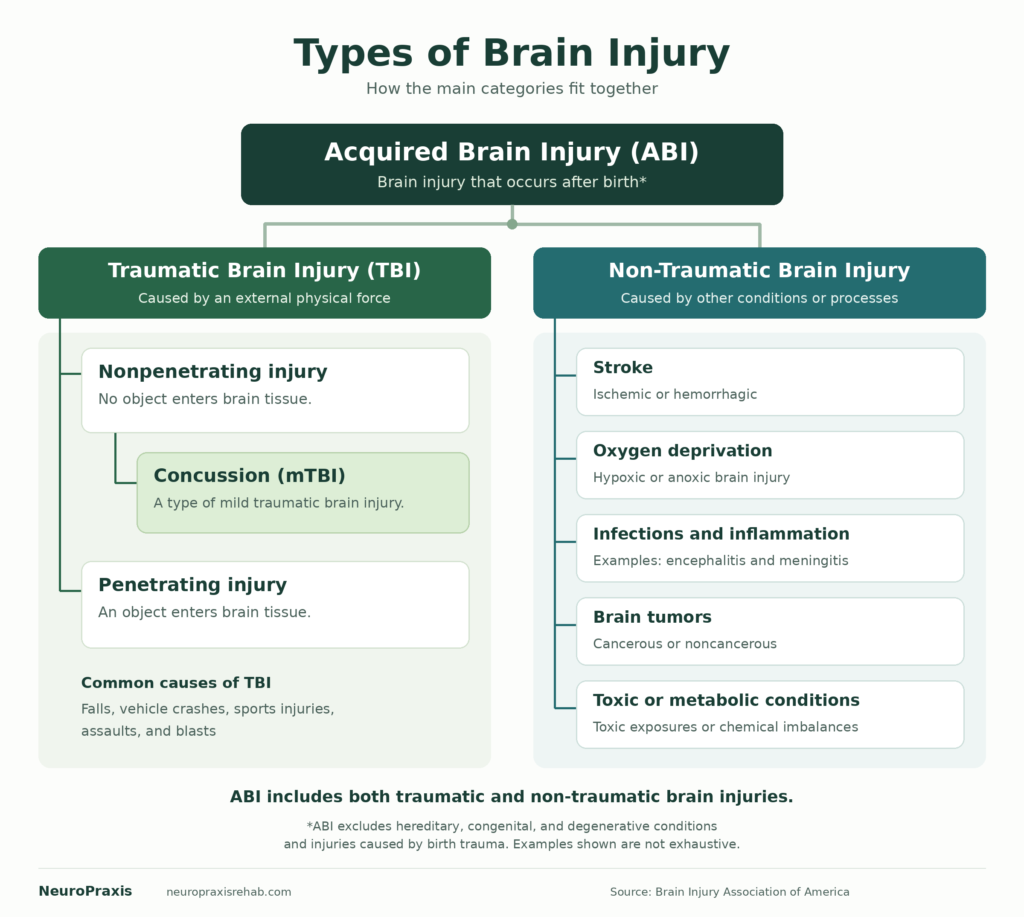
An acquired brain injury (ABI) occurs after birth. The Brain Injury Association of America excludes hereditary, congenital, and degenerative conditions and injuries caused by birth trauma from this category. Alzheimer’s disease, for example, is a degenerative condition and is not classified as ABI.
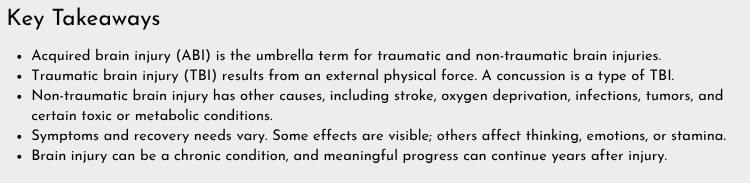
ABI includes two main categories: traumatic brain injury and non-traumatic brain injury. Although “ABI” is sometimes used to mean only a non-traumatic injury, TBI also belongs under this umbrella. The distinction describes the cause of the injury, not its impact on a person’s life.
Traumatic Brain Injury
A traumatic brain injury occurs when an external physical force disrupts brain function or damages brain tissue. Common causes include falls, vehicle collisions, sports injuries, workplace accidents, assaults, and blasts. An impact to the body can move the brain rapidly enough inside the skull to cause a traumatic injury, even when there is no direct blow to the head.
TBI are further differentiated by how the injury occurs:
- Nonpenetrating injury: The brain is injured without an object entering brain tissue. For example, rapid movement or rotation can cause damage to the tissue and blood vessels inside the skull.
- Penetrating injury: An object, such as a bullet or bone fragment, enters the skull and protective covering and goes into brain tissue. A skull fracture alone does not necessarily mean the injury is penetrating.
TBI is often classified as mild, moderate, or severe based on initial findings such as responsiveness, loss of consciousness, and the duration of confusion or memory disruption. These severity measures describe the initial injury but are not indicators of the severity of someone’s damage, long-term symptoms, or support needs.
A Concussion Is a Brain Injury
A concussion is a type of TBI, commonly classified as a mild TBI (mTBI). Surprisingly, in the case of a mTBI, a person does not have to lose consciousness, and routine imaging may appear normal. Typical symptoms include headache, dizziness, nausea, light sensitivity or or vision changes, slowed cognitve processing, irritability, impulsivity, and sleep changes.
Many people see improvement within days or weeks fro mTBI, while some people experience ongoing symptoms for months or longer. “Mild” does not mean the symptoms are mild or unimportant. The CDC recommends follow-up when symptoms persist beyond two to three weeks or worsen with regular activities. You can learn more in our article on common concussion myths.
Other Brain Injury Basics Terminology
Medical records may also describe the pattern of injury. These terms can overlap:
- Contusion: A bruise in brain tissue.
- Coup-contrecoup: Injuries at the impact site and on the opposite side of the brain.
- Diffuse axonal injury: Damage to nerve fibers called axons across multiple brain areas, often caused by rapid rotation. Axons help brain cells communicate.
- Secondary injury: Additional damage that develops after the initial injury through subsequent processes such as swelling, altered blood flow, or chemical changes.
Non-Traumatic Brain Injury Basics
A non-traumatic brain injury results from a medical condition, oxygen deprivation, toxic exposure, or a process other than an external force. “Non-traumatic” describes how the injury occurs, It does not mean the condition is less serious or the experience less distressing.
Stroke
A stroke is a non-traumatic acquired brain injury. It can damage brain tissue in two main ways:
- Ischemic stroke: A blood vessel supplying the brain becomes blocked, cutting off blood.
- Hemorrhagic stroke: A blood vessel leaks or ruptures, causing bleeding in or around the brain.
The effects depend on which brain areas are involved and may include various difficulties with movement, communication, thinking, and other functions.
Hypoxic and Anoxic Brain Injury
The brain needs a continuous oxygen supply. A hypoxic injury occurs when it receives too little oxygen. An anoxic injury occurs when oxygen supply is cut off. Causes can include cardiac arrest, drowning, choking, strangulation, and an overdose that suppresses breathing. The effects depend on the severity and duration of oxygen deprivation.
Other Non-Traumatic Causes
Other conditions can injure the brain through different processes:
- Infections and inflammation: Encephalitis affects brain tissue, while meningitis affects the protective membranes around the brain and spinal cord. Infection-related complications or an immune system attack can cause lasting difficulties.
- Brain tumors: Both cancerous and noncancerous tumors can press on or affect brain tissue and disrupt function.
- Toxic or metabolic conditions: Certain toxic exposures can damage the brain. Metabolic disturbances, such as chemical imbalances caused by organ failure, can also harm brain function.
Brain Injury Symptoms Can Be Visible or Invisible
Brain injury can affect how a person moves, thinks, feels, and manages their everyday activities. Some effects, such as weakness or difficulty walking, may be apparent to others. Problems with memory, fatigue, or emotional regulation can be harder to recognize during brief interactions, even when they significantly affect a person’s daily life. These physical, cognitive, and emotional changes may include:
- Thinking and communication: Difficulty remembering information, concentrating, planning, or finding words.
- Movement and vision: Weakness, poor coordination, balance problems, or vision changes.
- Energy and sleep: Headaches, fatigue, reduced stamina, or disrupted sleep.
- Emotions and behavior: Irritability, anxiety, depression, or changes in motivation.
Because many symptoms are not obvious, a person’s appearance may not accurately reflect the difficulties they are experiencing. For example, someone may comfortably manage a short conversation but struggle to return to work because of fatigue or difficulty concentrating. Understanding the effects of brain injury requires looking at how symptoms interfere with a person’s activities over their full day, including work, family responsibilities, household tasks, and relationships.

Brain Injury Can Be a Chronic Condition
An individual’s symptoms and support needs can change over time, making reassessment and continuing care important. The good news is that recovery can continue, too. TRACK-TBI research documented improved independence among moderate-to-severe TBI survivors between one and five years after injury. Learn more in Brain Injury Is a Chronic Condition.
Personalized Rehabilitation Supports Brain Change
Neuroplasticity, the brain’s ability to adapt, reorganize, and grow both physically and functionally, supports all learning and recovery. Personalized neurorehabilitation that understands how to encourage and direct neuroplasticity can connect a person’s meaningful goals with the appropriate practice and support. Treatment may include physical, occupational, speech-language, and cognitive rehabilitation, psychological care, and caregiver education.
At NeuroPraxis, in-home and community rehabilitation helps people practice skills where they actually use them, whether that means managing a daily routine, communicating with family, or navigating community settings. Each care plan reflects the individual’s abilities, environment, and goals.
We Are Here to Help
NeuroPraxis partners with physicians, case managers, discharge planners, workers’ compensation professionals, attorneys, and families. Our individualized neurorehabilitation services support long-term recovery after brain and spinal cord injury.
To discuss brain injury basics care for a family member or client, call 888.266.8921, email hello@neuropraxisrehab.com, or submit an online referral.